
Bathroom questions
What goes behind shower tile, and why does it matter?
Tile is the finish, not the protection. The part that keeps water out of your walls is a thin layer you will never see once the job is done.
Aleksei Kasatkin, owner of ORCA Build Group · Updated October 26, 2026
The layers, from studs to tile
| Layer | What it does |
|---|---|
| Wall studs and subfloor | What it doesThe structure. It has to be solid, flat and dry before anything goes on it. |
| Cement backer board | What it doesA stable base for tile that does not fall apart when wet. It is not waterproof. |
| Waterproof membrane | What it doesSheet or liquid, rated ANSI A118.10. This is the layer that stops water. |
| Thinset mortar | What it doesBonds the tile to the membrane. |
| Tile | What it doesThe surface you see and clean. |
| Grout | What it doesFills the joints between tiles. It absorbs water. |
On the floor, the base under the membrane slopes toward the drain at about 1/4 inch per foot, and the membrane is joined to the drain, so water that gets through the grout has a way out instead of sitting under the tile.
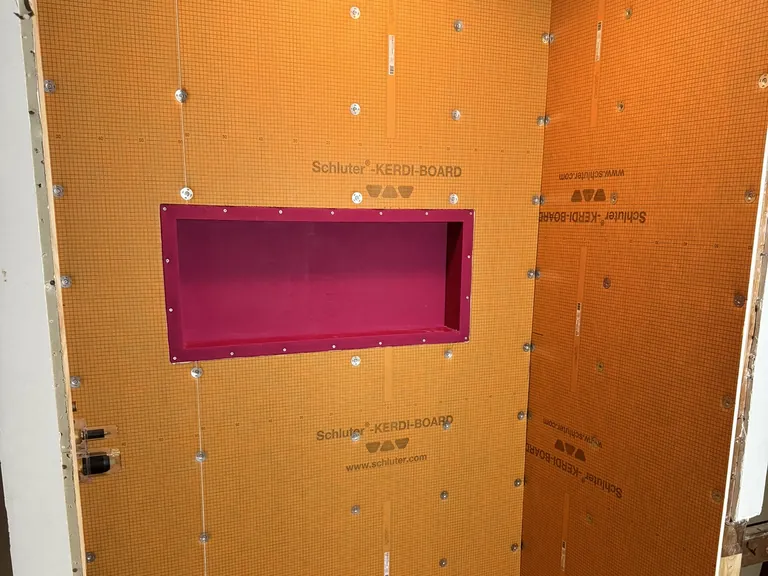
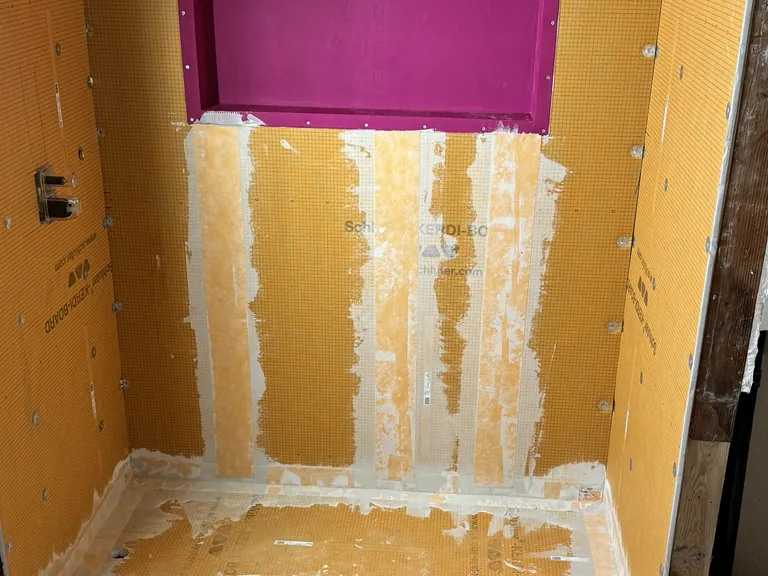
Another common system uses a foam backer board that is waterproof on its own. The seams, corners and screw heads still get membrane strips and patches, and the floor is joined to the drain the same way. That is what the photos below show.
Why grout and cement board are not enough
Cement grout is porous. Water soaks into it with every shower and dries out between them. Cement board behaves the same way: it does not rot or swell, but water passes through it. Without a membrane, that water reaches the studs and the subfloor. Sealing the grout slows the absorption. It does not make the wall waterproof.
The flood test
Before any tile goes on the floor, we plug the drain, fill the shower pan with water and leave it for 24 hours. If the level drops or there is any sign of water below, we find the leak and fix it while it is still a membrane repair, not a tear-out. Our technical supervisor checks the result before tile starts.
What failure looks like years later
A shower with poor waterproofing can look perfect for a long time. Then the signs start:
- Grout lines stay dark long after the shower has dried.
- Tiles near the floor or the valve sound hollow or come loose.
- Paint or baseboard outside the shower bubbles or peels.
- The floor next to the shower feels soft.
- A stain appears on the ceiling of the room below.
- The room smells musty even with the fan running.
By the time these show up, the fix is usually removing the tile, repairing the framing and doing the waterproofing again. That is why I do not recommend saving money on this layer. See also Signs of water damage in a bathroom.
Questions to ask any contractor
- Which membrane do you use, and is it rated ANSI A118.10?
- Does it cover the whole shower, including the floor, the niche and the bench?
- How is the floor sloped, and how is the membrane connected to the drain?
- Do you flood-test the pan before tile, and for how long?
- Can I see the waterproofing before the tile goes on?
- Who checks it, and what happens if the test fails?
A contractor who does this properly can answer each of these in a sentence or two. If the answer is "the grout is sealed" or "cement board is waterproof", keep looking.
Is a tub surround waterproofed the same way?
The walls are. They get the same backer board and membrane. The tub itself takes the place of the shower pan, so there is no flood test, but the membrane has to overlap the edge of the tub correctly, so water runs into the tub and not behind it.
Can a membrane be added without removing the existing tile?
No. The membrane goes under the tile. If an existing shower leaks behind the tile, the fix is to remove the tile and backer board down to the studs, repair whatever is wet, and rebuild the layers in the right order.
Related questions
- Should I replace my tub with a walk-in shower?
- How do I know if there is water damage under my bathroom floor?
- Cement, urethane or epoxy grout: which should I choose?
- All bathroom guides
Codes and permit rules change, and each Bay Area city applies them a little differently. Treat this page as a starting point and confirm the requirements for your address before work begins. We do that as part of every written estimate.
Have a bathroom question this page did not answer?
Send 2–3 photos and tell me what bothers you about the room. I reply with a price range and what I would check first.